The Two-Line Badge That Beats Small Talk at Any UK SME Meet-Up
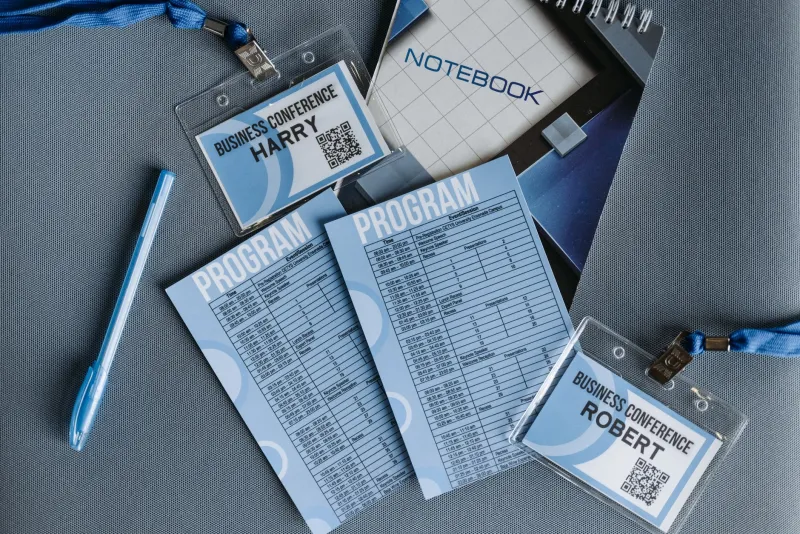
Walk into almost any UK SME meet-up in 2026 and you’ll see the same badge: name, company, job title. It’s efficient. It’s also a bit of a status scanner. People glance at the title, decide whether you’re useful, senior or safe, and then ask the same question they ask everyone: “So, what do you do?”
That question isn’t terrible. It’s just slow. And at a room full of regional business owners who have already answered it three times before the coffee has gone cold, it can turn a promising conversation into a CV recital.
There’s a small fix that costs almost nothing and changes the tone of the room: give every badge two extra lines. Not a slogan, not a pitch, just two prompts that do the introductions for you.
Why the standard badge stalls
A job title is a label, not a conversation starter. “Managing Director” tells me your role. It doesn’t tell me whether you’ve just solved the same staffing problem I’m wrestling with, whether you know a decent commercial printer in Leeds, or whether you’re the person who can explain Making Tax Digital without making me want to lie down.
Worse, titles encourage horizontal scanning. People look for someone senior, someone in their sector, someone who might buy. That’s not networking; it’s LinkedIn with lukewarm tea. The badges that work hardest are the ones that give people a reason to speak first.
The two-line addition
Keep the name, company and title if you like. Then add:
- Ask me about: a current problem, project or curiosity.
- I can help with: something specific, practical and free to share.
Examples from a fictional but entirely plausible West Midlands meet-up:
- Ask me about: moving from spreadsheets to proper stock control
- I can help with: finding a reliable van hire in Coventry
Or:
- Ask me about: hiring a first apprentice
- I can help with: plain-English employment contracts
Notice what these lines do. They’re specific enough to be useful, broad enough to invite a conversation, and they don’t demand a sale. The first line gives you permission to ask. The second gives you permission to offer. Neither requires a pitch deck.
A printable template that actually works
The simplest version is a sticker sheet. Print labels with three fields: name, “Ask me about” and “I can help with”. Leave the last two blank and hand people a chunky marker pen at the door. If you want to pre-print, send a two-field form with the booking confirmation. Keep it optional; some people will freeze if you ask them to be interesting in advance.
A workable badge layout looks like this:
| Line | Example | Why it works |
|---|---|---|
| Name | Priya Shah | Easy to read from a sensible distance |
| Company | Shah & Co | Context without hierarchy |
| Ask me about | Finding a part-time bookkeeper | Specific, current and easy to answer |
| I can help with | Spreadsheet clean-ups | Useful, bounded and not a sales pitch |
Use a font size that works at arm’s length. Avoid pale grey text on white. And please, no lanyards that spin round to show a blank back. If the badge is going to start conversations, it needs to be legible after the first glass of something.
The host script, word for word
You don’t need a theatrical welcome. You need sixty seconds that explain the rules without making the room groan. Here’s a script that works:
“Quick one before we start. Have a look at your badge. You’ve got two lines to fill in: what you’d like to talk about, and what you can help someone with. It doesn’t have to be clever. ‘Ask me about my disastrous first year of VAT’ is a perfectly good answer. If you’re stuck, look at someone else’s badge and ask them about their line. That’s the whole icebreaker. Pens are by the door.”
Then model it yourself. The host’s badge should have real answers on it. If the person running the room has written “business strategy” under “I can help with”, everyone else will reach for vague, impressive-sounding nonsense. If they’ve written “introductions to independent cafés in Bristol”, the room relaxes.
Practical tips for the room
Keep the title small. It can stay, but it shouldn’t be the biggest thing on the badge. The prompts are the point.
Have a badge doctor at the door. One person with a marker pen and a friendly line: “What are you hoping to talk about today?” It takes ten seconds and saves the shyest attendee from writing “networking” in desperation.
Don’t let it become a pitch. “I can help with” is not “I sell”. If someone writes “SEO packages”, gently suggest they narrow it to “quick website checks” or “explaining what Google actually wants”. Specific beats salesy.
Use it for introductions. As host, you can scan the room and match people: “You two should talk; she’s asking about exactly what you’ve put under ‘I can help with’.” That’s the sort of thing that makes a meet-up feel useful rather than merely attended.
Make it optional but visible. Some people hate badges. Fine. Offer a clip-on version or a sticker. But have enough people using the prompts that the room catches on.
What happens after the event
Don’t over-engineer it. You don’t need an app. If you collect the badge sheets, you can use them to suggest one or two follow-ups: “You mentioned you were looking for a part-time bookkeeper; I spoke to someone on Thursday who does exactly that.” That’s a member benefit in one sentence.
And if you’re running a regular meet-up, keep a bank of good examples. Not to shame anyone, just to show newcomers that “Ask me about: whether it’s worth switching to a limited company” is a perfectly normal thing to write on a badge.
The badge is the first handshake. It might as well do some of the work.